

Choosing an Interactive Lantern: Visitor Action, Trigger, and Response
An interactive lantern project starts with a simple question: what should visitors do, and how should the display respond? For a park, zoo, or lantern festival, a useful brief connects the visitor’s action with a visible result. A striking appearance alone does not explain that relationship.
Before discussing individual features, separate three things: the action visitors take, the condition that triggers a response, and what the lantern does next. This helps a buyer and supplier discuss the same experience instead of attaching different meanings to “interactive.”
Visitor-Triggered or Automatically Repeating?
A lantern can move without responding to visitors. A flower that opens and closes on a repeating sequence is animated, but the movement alone does not establish a visitor-triggered interaction. Likewise, a walk-through installation does not necessarily change in response to someone entering it.
For a visitor-triggered concept, describe the connection explicitly: a person approaches or performs an action, the agreed trigger condition is met, and the display responds. The response might involve a visible movement or a change in light, depending on the confirmed design. These are ways to describe a requirement, not a list of functions available on every lantern.
For the separate decision about whether mechanical movement suits a scene, see our guide to static and animated lantern displays.
An Infrared-Triggered Peacock Example
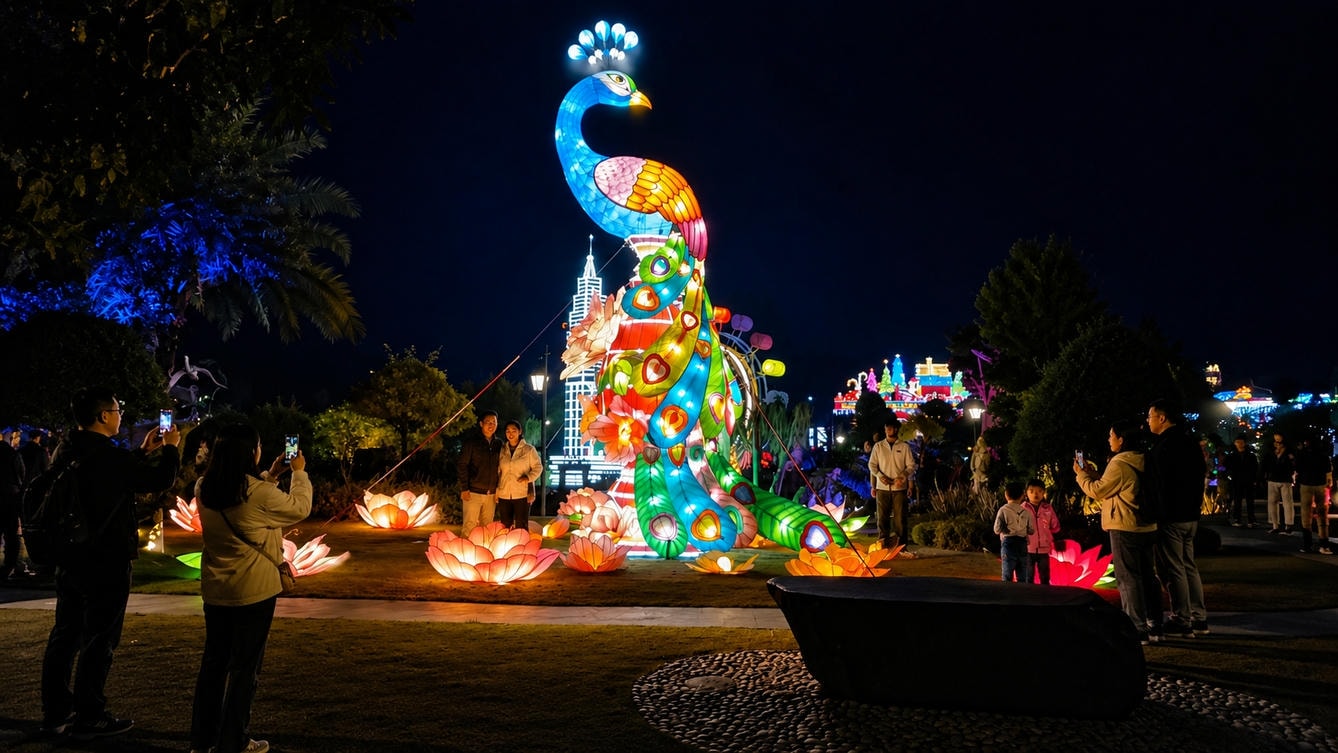
One interactive lantern project described by the HOYECHI team used a peacock-opening display. In that project’s setup, a person passing by and remaining for 10 seconds would trigger a motor-driven opening action through an infrared-based arrangement.
The important distinction is the sequence: passing by was not described as an immediate trigger. The visitor remained, the configured condition was met, and the motor drove the opening mechanism. That gives the buyer a more specific reference than simply asking for “a moving peacock.”
The 10-second setting belongs to this example. It is not a standard delay for all interactive lanterns or a recommended setting for every venue. Detection arrangements, repeat activation, and the return to a starting state need to be discussed for the actual project; this example does not specify those details.
Why Our Team Favors Infrared in This Experience
In the team’s practical experience, infrared-based arrangements have been comparatively straightforward to implement and activate, with relatively few faults encountered. That experience makes infrared a useful starting point for discussing some visitor-triggered concepts.
It is not a universal comparison of sensing technologies or a measured failure-rate guarantee. A buyer should still confirm the proposed function and its suitability for the intended setting rather than assume that an infrared label answers every operating question.
Describe What Visitors Do and What the Lantern Should Do
A useful initial brief can be short. Explain the expected interaction in plain language before asking for a particular device or technical configuration.
| Part of the brief | What to explain |
|---|---|
| Visitor action | What should the visitor do to participate? |
| Trigger condition | Should the response follow arrival, a period of remaining nearby, or another agreed action? |
| Visible response | What should the visitor see after the condition is met? |
| Next interaction | What should happen before another visitor can participate? |
| Display setting | Where will the lantern be placed, and from where will visitors approach and watch? |
The peacock example supplies one confirmed interaction sequence, not default answers for every row. If you have a reference video, identify the behavior you want to discuss rather than assume that every visible effect or hidden function is included.
For the wider site plan, theme, scale, and visual approval process, use the custom lantern festival design guide.
Confirm Settings and Day-to-Day Use
Ask the supplier to clarify which behavior is proposed and which details remain unresolved. Useful questions include whether another person can trigger the display during an existing action, how it becomes ready for the next interaction, and how the intended sequence will be demonstrated before approval.
Discuss operation and maintenance alongside the visual effect. Identify who will operate the display, who will report an unexpected response, and which support arrangements are included in the agreed scope. These are project questions—not a universal maintenance schedule or a promise that the display requires no attention.
A rendering can help confirm appearance. For an interactive requirement, also request a demonstration of the agreed visitor action and resulting response. Footage of a lantern moving by itself does not show how that movement was triggered.
Discuss the Interaction as Part of the Lantern Project
An interactive feature should have a clear role within the surrounding lantern festival displays. Start with the experience you want to create, then confirm the function, setting, and operating expectations together.
Discuss your interactive lantern idea: tell us what you want visitors to do, how you want the lantern to respond, and share reference information about the venue.
Post time: Jun-22-2025


